If you have asked two sealcoating companies for a driveway quote, you have probably gotten two very different prices — sometimes 50 percent apart. The wide range is not random. Sealcoating prices in Ohio reflect material quality, coat count, surface prep, and crew experience, and a $0.15-per-square-foot quote does very different work than a $0.30 quote. This guide walks through real 2026 driveway sealcoating costs across Lebanon, Mason, Springboro, Cincinnati, and the broader Warren County area, what actually drives the price, and how to evaluate quotes line by line so you can pick the right contractor.
How much does driveway sealcoating cost in Ohio in 2026?
Most Ohio residential driveway sealcoating jobs in 2026 fall between $0.18 and $0.32 per square foot, with most established contractors landing in the $0.20 to $0.28 range. For a typical 600 to 1,000 square foot driveway, that translates to:
- Small driveway (400 to 600 sq ft): $120 to $200
- Standard driveway (600 to 1,000 sq ft): $180 to $320
- Large driveway (1,000 to 2,000 sq ft): $300 to $640
- Long rural driveway (2,000+ sq ft): $500+ depending on length and access
Most contractors have a minimum charge — typically $200 to $300 — to make smaller jobs worth dispatching a crew. A $90 quote for a small driveway usually means the crew is doing one coat with thinned material and not coming back if it fails.
What is included in a sealcoating job?
A complete residential sealcoating job in Ohio should include all of the following — verify each before signing a quote:
- Surface cleaning — power blowing or pressure washing to remove dirt, debris, and loose stone
- Crack filling — hot rubberized crack sealant on cracks 1/4 inch and wider; thin cracks are sealed by the coating itself
- Oil spot priming — petroleum-based oil stains repel sealer; primer ensures adhesion
- Edging — hand-cut edges along grass, garage doors, and walkways
- First coat — applied with squeegee or spray; spray gives even coverage on textured asphalt, squeegee fills small voids
- Second coat — applied after the first dries (1 to 4 hours depending on humidity)
- Curing protection — barricade tape, cones, or rope to keep the driveway off-limits during cure
- Cleanup — debris hauled, edges wiped, splatter cleaned from garage doors and concrete walkways
Quotes that skip the crack filling, oil spot priming, or second coat are doing a fraction of the actual work. The price difference reflects scope, not just labor.
What affects the price of sealcoating a driveway?
Six variables move the price most:
- Square footage — the biggest factor; sealcoating is priced primarily by area
- Surface condition — heavy alligator cracking, multiple oil stains, and edge erosion all add prep time
- Number of coats — most quality jobs are two coats; one-coat “maintenance” jobs are about 60 percent of the price but last about half as long
- Material quality — coal tar emulsion (most durable, traditional), asphalt-based emulsion (greener, slightly less durable), or polymer-modified blends (premium, longest life)
- Access and crew time — long rural driveways, steep grades, or driveways that share access with cars and equipment cost more per square foot
- Time of year — peak season (June through September) firms up pricing; spring and late-fall windows can deliver 10 to 15 percent better quotes
How often should I sealcoat my Ohio driveway?
The honest answer is every 2 to 3 years for most Ohio residential driveways, with the first sealcoat happening 6 to 12 months after the asphalt is laid (the asphalt has to fully cure before sealing). Skip the first sealcoat too long and the binder oxidizes; sealcoat too often and you get sealer buildup that flakes.
Signals that your driveway needs sealcoating now:
- The surface looks gray or brown rather than deep black
- Small surface cracks have started to appear
- Water absorbs into the surface instead of beading
- Visible aggregate (the small stones) is exposed
- It has been more than 3 years since the last sealcoat
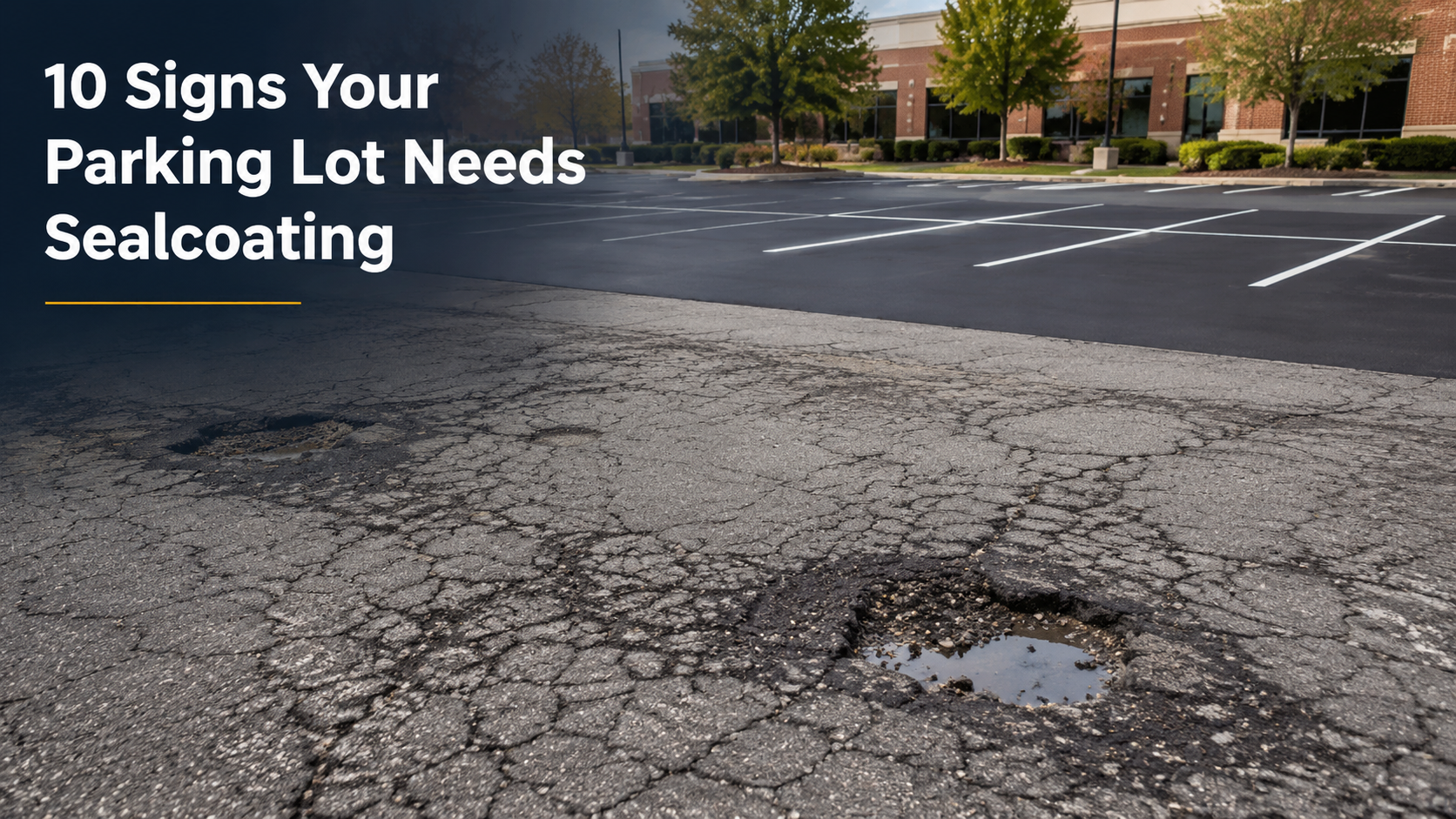
If the driveway has alligator cracking (interconnected cracks like reptile scales), sealcoating alone will not fix it — that is structural failure, and patching or partial replacement is the right move first.
What is the difference between coal tar and asphalt-based sealer?
The two most common sealcoating materials in Ohio:
- Coal tar emulsion (RTS): the traditional standard, highest UV resistance, deepest black color, longest life. Slightly stronger smell during application. Best for high-sun-exposure driveways and parking lots
- Asphalt-based emulsion: made from refined asphalt, low odor, more environmentally friendly, slightly less UV resistance. Most homeowners cannot tell the difference visually after curing
- Polymer-modified sealers: blends with added polymers for flexibility and longer life — premium tier, typically 15 to 25 percent more expensive than standard
For most Ohio residential driveways, both coal tar and asphalt-based deliver excellent results. Ask which the contractor uses and confirm that they apply two coats regardless.
What is the best time of year to sealcoat in Ohio?
Sealcoating cures best between 50°F and 90°F with low humidity and no rain in the 24-hour forecast. In Ohio, that gives roughly mid-May through early October as the working window, with the sweet spots being:
- Late spring (May to June): moderate temps, lower humidity than mid-summer; ideal for proper cure
- Early fall (mid-September to early October): stable temps, less rain, sealer locks in protection before freeze-thaw season
July and August are the busiest months but high humidity slows cure times. Avoid sealcoating after mid-October — overnight temps drop below 50°F and the sealer cannot bond properly. A contractor willing to seal in November is risking your driveway looking patchy and peeling by spring.
Can I sealcoat my driveway myself?
You can, and the bucket-from-the-hardware-store approach runs about $80 to $150 in materials for a typical driveway. The math reasons most homeowners hire a professional anyway:
- DIY sealers are typically thinner consumer-grade formulations that last 1 year vs. 2 to 3 for commercial-grade
- Two coats applied properly takes most homeowners 4 to 6 hours of work plus equipment
- Edging, crack filling, and oil priming require specialized materials and skill
- Coverage rate matters — under-applying produces a patchy result; over-applying wastes material
- Splatter on the garage door, sidewalk, and grass is hard to clean
If your driveway is small, in good condition, and you enjoy weekend projects, DIY is reasonable. For most Ohio homeowners, the $200 to $400 to hire a professional pays for the longer-lasting result and the saved Saturday.
How long does sealcoating last in Ohio?
A properly applied two-coat sealcoat with quality materials typically lasts 2 to 3 years in Ohio’s climate. Variables:
- Sun exposure — driveways in full sun fade faster than shaded ones
- Traffic volume — heavy daily use wears the surface
- De-icing salt exposure — winter salt accelerates degradation
- Quality of original asphalt — a poorly installed driveway will not hold sealer well no matter what
- Coat count and material — two coats of commercial-grade outperform one coat of premium every time
How do I compare sealcoating quotes the right way?
Use this checklist when reviewing bids:
- Square footage being sealed (measure to verify)
- Number of coats included (one or two)
- Sealer type and brand (coal tar, asphalt-based, polymer-modified)
- Crack filling — included or extra; what crack width threshold
- Oil spot priming — included or extra
- Hand-cut edging and trim work
- Cure time and cars-off requirement (typically 24 to 48 hours)
- Warranty (standard is 12 months on workmanship)
- Insurance — general liability minimum $1M, COI provided
- Local references in your area
What are the red flags in sealcoating quotes?
- Door-to-door pitches with leftover material — “we have extra sealer from a job down the street” is the oldest scam in the industry; the sealer is usually thinned and the work disappears in 6 months
- Suspiciously low pricing — under $0.10 per square foot almost always means thinned material and one diluted coat
- Cash-only or large upfront deposits — legitimate contractors take checks or cards, with full payment after the work is complete
- No physical address or commercial vehicle — real local contractors are easy to verify
- Pressure to sign immediately — sealcoating is not an emergency; legitimate contractors give you time to compare
- Vague scope — “we’ll seal it” is not a scope; demand a written line-by-line quote
How do I find a good sealcoating contractor in Ohio?
Michelson’s Sealcoating provides driveway and parking lot sealcoating across Lebanon, Mason, Springboro, Clarksville, and the broader Warren County and Greater Cincinnati area. Every job is two coats of commercial-grade sealer, hand-cut edging, hot rubberized crack filling, and oil-spot priming where needed. Free written quotes with line-item scope, full insurance, and a 12-month workmanship warranty on every residential project.
If you are weighing sealcoating quotes in Ohio, the right move is to ask each contractor for a written scope — not a number on the back of a card — and compare line by line. The contractor whose quote actually answers the questions above is the one you want on your driveway.